flow-control-benchmarks
Long-context admission comparison
Business question
Does exact input-token admission protect realtime latency from a burst of large requests better than request-count admission?
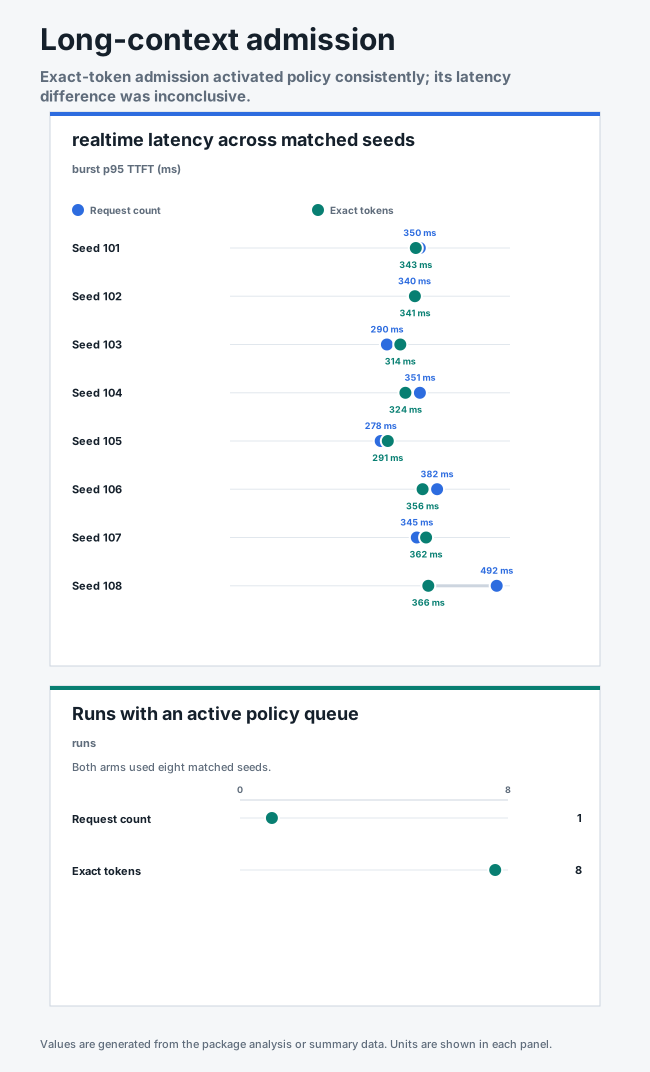
Answer. Exact input-token admission detected large-request pressure in all eight runs, but it did not produce a statistically significant realtime latency improvement over request-count admission.
Visual summary
Replay this package with Flow Control Flight Recorder
Result
Exact-token admission made large-request pressure visible to flow control. It formed a policy queue in all eight runs, compared with one of eight request-count runs.
| Measure | Request-count admission | Exact-token admission |
|---|---|---|
| Mean realtime burst p95 TTFT | 354 ms | 337 ms |
| Runs with an active policy queue | 1 / 8 | 8 / 8 |
| Successful requests | 18,453 / 18,453 | 18,453 / 18,453 |
The 16 ms p95 TTFT difference was small relative to run variance. The paired
test returned p=0.367, and the 95% confidence interval ranged from -24 ms to
57 ms. This data supports the detector behavior and does not establish a
general latency advantage.
Decision
Keep request-count admission at 128 requests with 10% headroom as the default. Use exact-token admission when request sizes vary enough to require size-aware queue activation.
Method
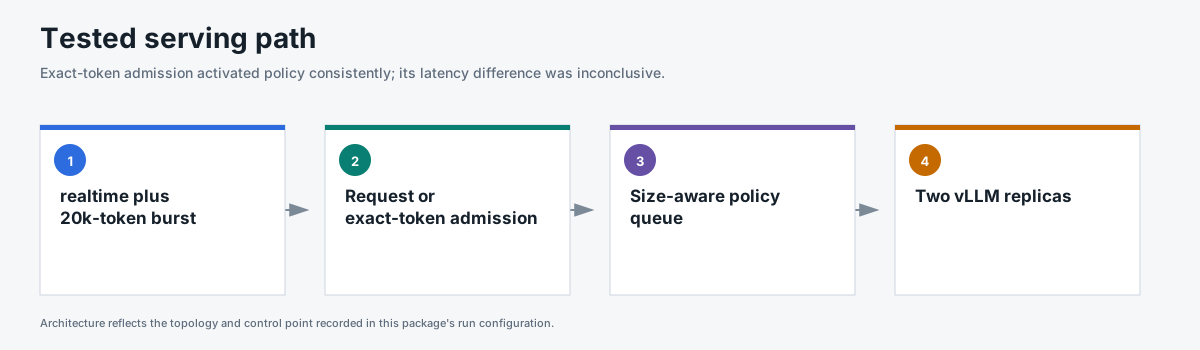
- One Endpoint Picker served two vLLM model replicas, each on one NVIDIA H100.
- realtime chat used 1,024 input tokens and 128 output tokens at a steady noisy rate.
- Standard-priority pressure used a timed burst of 20,000 input tokens and 128 output tokens.
- Request-count admission used 128 requests per model replica and 10% headroom.
- Exact-token admission used the vLLM tokenizer, a 20,000 input-token cap per model replica, and 25% headroom.
- The same open-loop noisy sinusoidal trace was replayed for both methods across eight frozen seeds.
- Prefix caching was disabled and verified by configuration and counters.
The complete configuration is in run-config.json.
Evidence
| File | Contents |
|---|---|
summary.csv |
Per-run realtime and long-context latency, queue, KV-cache, and response counts. |
request-results.csv |
One sanitized row per request across all 16 runs. |
traffic-samples.csv |
Issued, completed, and outstanding requests over time. |
system-metrics.csv |
Curated Endpoint Picker and per-model vLLM metrics. |
run-evidence.csv |
Schedule, headers, routes, request shapes, cache state, metrics, and flow-control engagement. |
analysis.json |
Paired seed results, confidence interval, statistical test, decision, and claim boundary. |
All 16 runs passed the data-quality, schedule, request-shape, header, route, stream, metric, cache, preemption, and restart checks. The flow-control proof gate records queue activation separately, so inactive request-count runs remain usable detector-boundary evidence.
Scope
The result applies to this model, hardware, two-replica topology, and tested traffic shape. Exact-token admission counts input size more accurately. It does not measure KV-memory use directly, so KV-cache and preemption metrics remain part of the evidence.
Reproduce
This package used GuideLLM 0.7.0 with two model replicas, random routing, cache off, and eight paired traffic seeds. It compared request-count admission at 128 requests and 10% headroom with exact input-token admission at 20,000 tokens per replica and 25% headroom.
for SEED in 101 102 103 104 105 106 107 108; do
  TRACE_DIR="/tmp/long-context-$SEED"
  python3 pipeline/guidellm_trace.py \
    --scenario-file benchmark-data/upstream-flow-control-v0.9.0/long-context-admission/scenario.json \
    --scenario premium_with_long_context_burst --out-dir "$TRACE_DIR" \
    --traffic-seed "$SEED"

  python3 pipeline/run_guidellm_scenario.py \
    --manifest "$TRACE_DIR/manifest.json" \
    --run-dir "results/long-context/request-count/seed-$SEED" \
    --prefix "long-context-request-count-seed-$SEED" \
    --namespace "${NAMESPACE:-flow-control}" \
    --runner-pod "${RUNNER_POD:-flow-control-benchmark-runner}" \
    --expected-detector concurrency-detector \
    --expected-concurrency-mode requests --expected-max-concurrency 128 \
    --expected-add-estimated-output-tokens false --expected-headroom 0.10 \
    --expected-picker random-picker --expected-prefix-cache off \
    --expected-model-replicas 2 --http-version 1 \
    --guidellm-worker-processes 10 --drain-after-done \
    --recover-multiline-sse

  python3 pipeline/run_guidellm_scenario.py \
    --manifest "$TRACE_DIR/manifest.json" \
    --run-dir "results/long-context/input-token/seed-$SEED" \
    --prefix "long-context-input-token-seed-$SEED" \
    --namespace "${NAMESPACE:-flow-control}" \
    --runner-pod "${RUNNER_POD:-flow-control-benchmark-runner}" \
    --expected-detector concurrency-detector \
    --expected-concurrency-mode tokens --expected-max-token-concurrency 20000 \
    --expected-add-estimated-output-tokens false --expected-headroom 0.25 \
    --expected-picker random-picker --expected-prefix-cache off \
    --expected-model-replicas 2 --http-version 1 \
    --guidellm-worker-processes 10 --drain-after-done \
    --recover-multiline-sse
done
scenario.json defines the matched traffic. run-config.json defines both admission configurations without placeholders.