flow-control-benchmarks
Request and token admission calibration
Business question
How many requests should enter vLLM, and when should request size affect that decision?
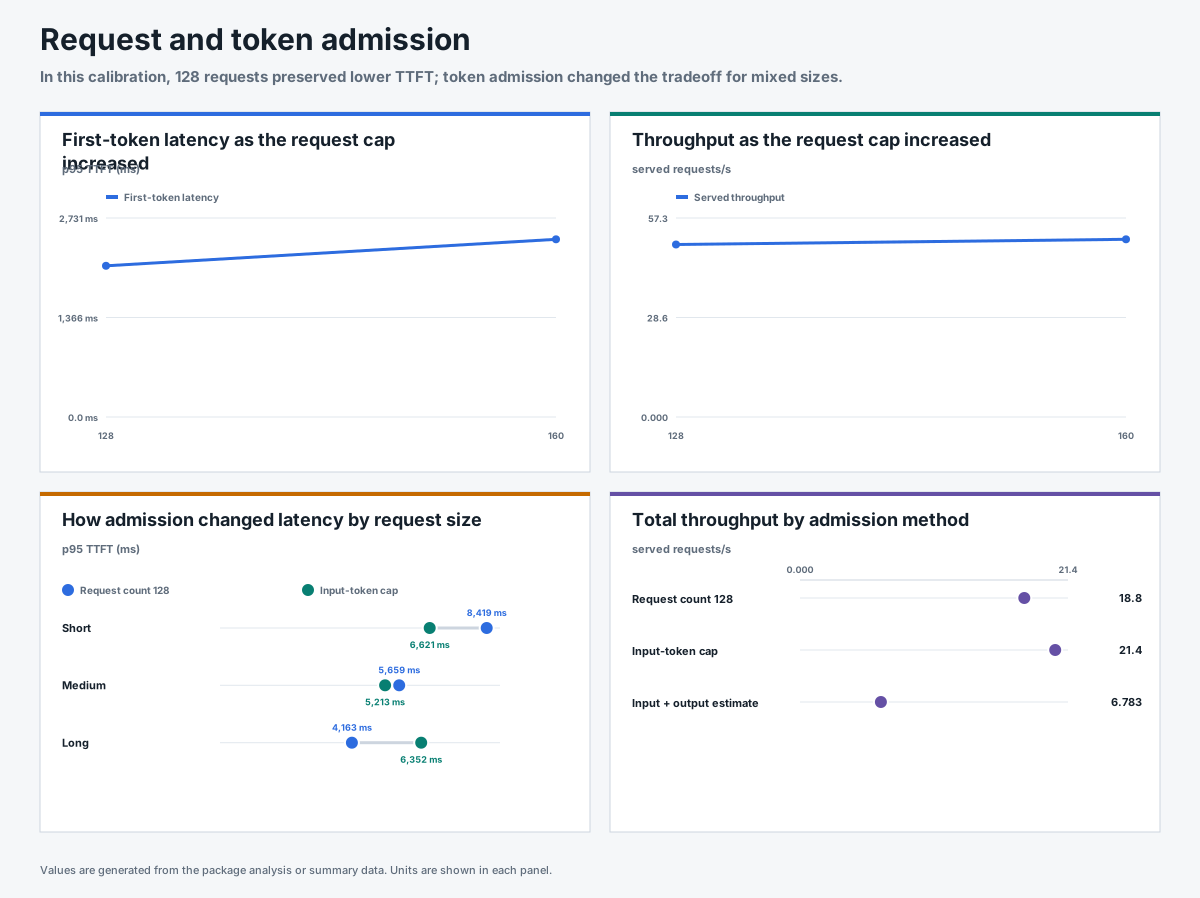
Answer. In this one-GPU calibration, a 128-request cap preserved lower first-token latency with a small throughput tradeoff; input-token admission became useful when request sizes varied materially.
Visual summary
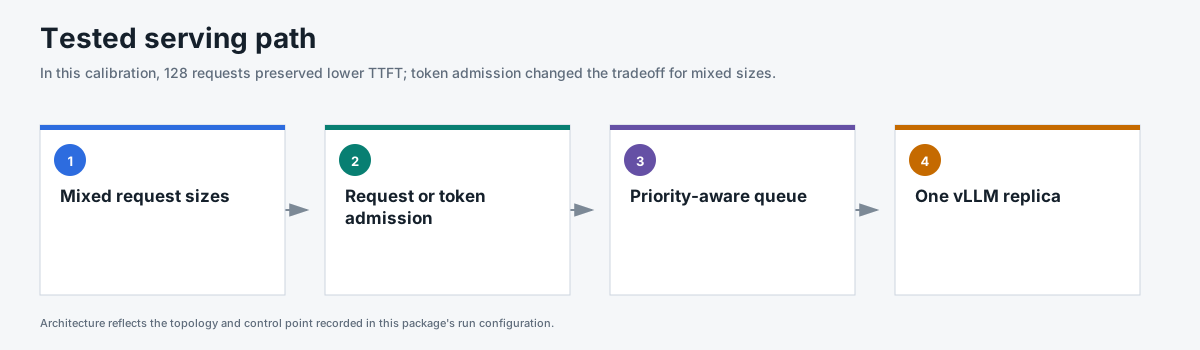
Replay this package with Flow Control Flight Recorder
Request-count result
Request cap 128 was selected for the later production tests. Cap 160 served 3.0% more steady traffic, but its median p95 TTFT was 363 ms higher and its p99 TTFT was 543 ms higher.
| Request cap | Repeats | Steady RPS | p95 TTFT | p99 TTFT | 429 rate |
|---|---|---|---|---|---|
| 128 | 3 | 49.6 | 2,076 ms | 2,548 ms | 1.9% |
| 160 | 3 | 51.1 | 2,439 ms | 3,091 ms | 1.4% |
The 429 responses are measured backpressure at the selected boundary. This closed-loop sweep identifies capacity; it does not define an acceptable production rejection rate.
Mixed-size result
Input-token admission served more total work and improved short-request p95 TTFT in this mixed-size calibration. It also increased long-request p95 TTFT.
| Admission setting | Repeats | Total steady RPS | Short p95 TTFT | Medium p95 TTFT | Long p95 TTFT |
|---|---|---|---|---|---|
| Request count 128 | 3 | 18.81 | 8,419 ms | 5,659 ms | 4,163 ms |
| Input-token cap 148,480 | 3 | 21.40 | 6,621 ms | 5,213 ms | 6,352 ms |
| Input plus output estimate | 1 | 6.78 | 41,909 ms | 27,952 ms | 13,962 ms |
Use request count 128 as the tested starting point for this one-GPU workload. Input-token admission is a workload-specific option when request sizes vary enough to require size-aware control. The tested output estimator assumed too much future work and does not advance.
Important tradeoff
Token admission estimates request size, not KV-memory use. Large prompts can still create memory pressure, so every production run also records KV-cache utilization and preemptions.
Method
- One llm-d Endpoint Picker v0.9.0 served one vLLM model replica on one NVIDIA H100.
- Prefix caching was disabled and verified by configuration and counters.
- The request-count sweep tested caps 16, 32, 48, 64, 96, 128, and 160.
- The mixed-size sweep combined 512-, 2,048-, and 8,192-token inputs with 128-token outputs.
- Selected boundaries have three matched runs. Other values are labeled calibration points.
- Every retained run captured request rows, traffic, policy queues, in-flight requests and tokens, vLLM waiting, KV utilization, preemptions, route counts, and cache counters.
Evidence
| File | Contents |
|---|---|
summary.csv |
Per-run and per-request-shape throughput and latency. |
admission-comparison.csv |
Matched mixed-size comparison with explicit units and capacity metrics. |
request-results.csv |
One sanitized row per request. |
traffic-samples.csv |
Issued, completed, and outstanding requests over time. |
system-metrics.csv |
Curated admission, queue, vLLM, KV-cache, and preemption metrics. |
run-evidence.csv |
Metrics, routes, headers, cache state, engagement, and proof gates. |
analysis.json |
Matched medians, decision, and claim boundary. |
Scope
These are closed-loop admission calibrations. The selected settings are tested separately with open-loop noisy traffic before any production SLO claim.
Reproduce
These cache-off closed-loop sweeps used the current pipeline/benchmark.py. Request-count caps were 16, 32, 48, 64, 96, 128, and 160. Token admission tested input-token limits at 0.8, 1.0, and 1.2 times measured capacity, plus a fixed output-token estimate. Selected points and boundaries ran three times.
OUTPUT_DIR=${OUTPUT_DIR:-results/request-and-token-admission-calibration}
PROMPT_CACHE_DIR=${PROMPT_CACHE_DIR:?Set the generated prompt-cache directory}
SCENARIO_FILE=${SCENARIO_FILE:-benchmark-data/upstream-flow-control-v0.9.0/request-and-token-admission-calibration/request-concurrency-scenario.json}
SCENARIO_FILTER=${SCENARIO_FILTER:-request_concurrency_calibration}

pipeline/run-in-cluster.sh \
  "$OUTPUT_DIR" "$OUTPUT_DIR/live-status.json" "$PROMPT_CACHE_DIR" \
  "$SCENARIO_FILE" -- --scenario-filter "$SCENARIO_FILTER" \
  --prompt-pool-size 24 --warmup-duration 30 --warmup-concurrency 2 \
  --steady-state-trim-s 30 --metric-sample-interval-s 0.5 \
  --vllm-prefix-caching off --traffic-seed 42 --arrival-mode closed_loop
For token admission, set SCENARIO_FILE to token-admission-scenario.json and SCENARIO_FILTER to token_admission_calibration. Set the tested request or token cap in the Endpoint Picker before each point. Both traffic definitions are published beside this README; run-config.json records the images and metric cadence.